

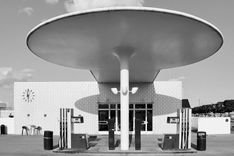
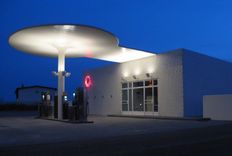
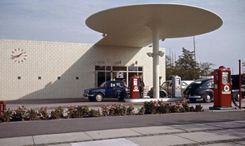
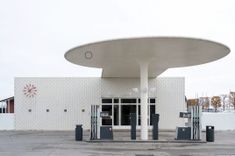
The single-storey, square building was originally equipped with a workshop, an office, a boiler room and a toilet room. Cars could drive into the workshop through two garage doors on the north side. The only windows are on the west side of the petrol station, next to doors through which the cash desk area was accessed. The roof of the petrol station building has its highest point on the street side and slopes evenly towards the rear. A clock illuminated in red at night hangs on the façade, although it was only installed at a later date.
The round, mushroom-shaped roof with a single concrete pillar is painted white on its underside and is indirectly illuminated by three spotlights on the building and four spotlights on the pillar. The reflection of the light means that the tank area is also brightly lit at night. The shape of the canopy is reminiscent of the backrest of the ant, a chair designed by Jacobsen in 1952. The building, the canopy and the support are reinforced concrete structures. The façade of the petrol station building is also clad with white ceramic tiles. All edges and corners of the building, the roof and the support are rounded and smoothly moulded. This design feature contributes significantly to the impression of uniformity of the building.
The petrol station is still in operation and has two pumps under the canopy. The interior, which was originally used as an office, has since been converted into an ice cream parlour. In 2003, the architectural firm Dissing + Weitling (the architects Otto Weitling and Hans Dissing were former employees of Arne Jacobsen) restored the petrol station on behalf of Gentofte Municipality. The tiles on the façade were replaced in the process. [1]
[1] vielfaltdermoderne.de/skovshoved (18.04.25)
Merci, Jan Horváth